An American Genocide by Benjamin Madley
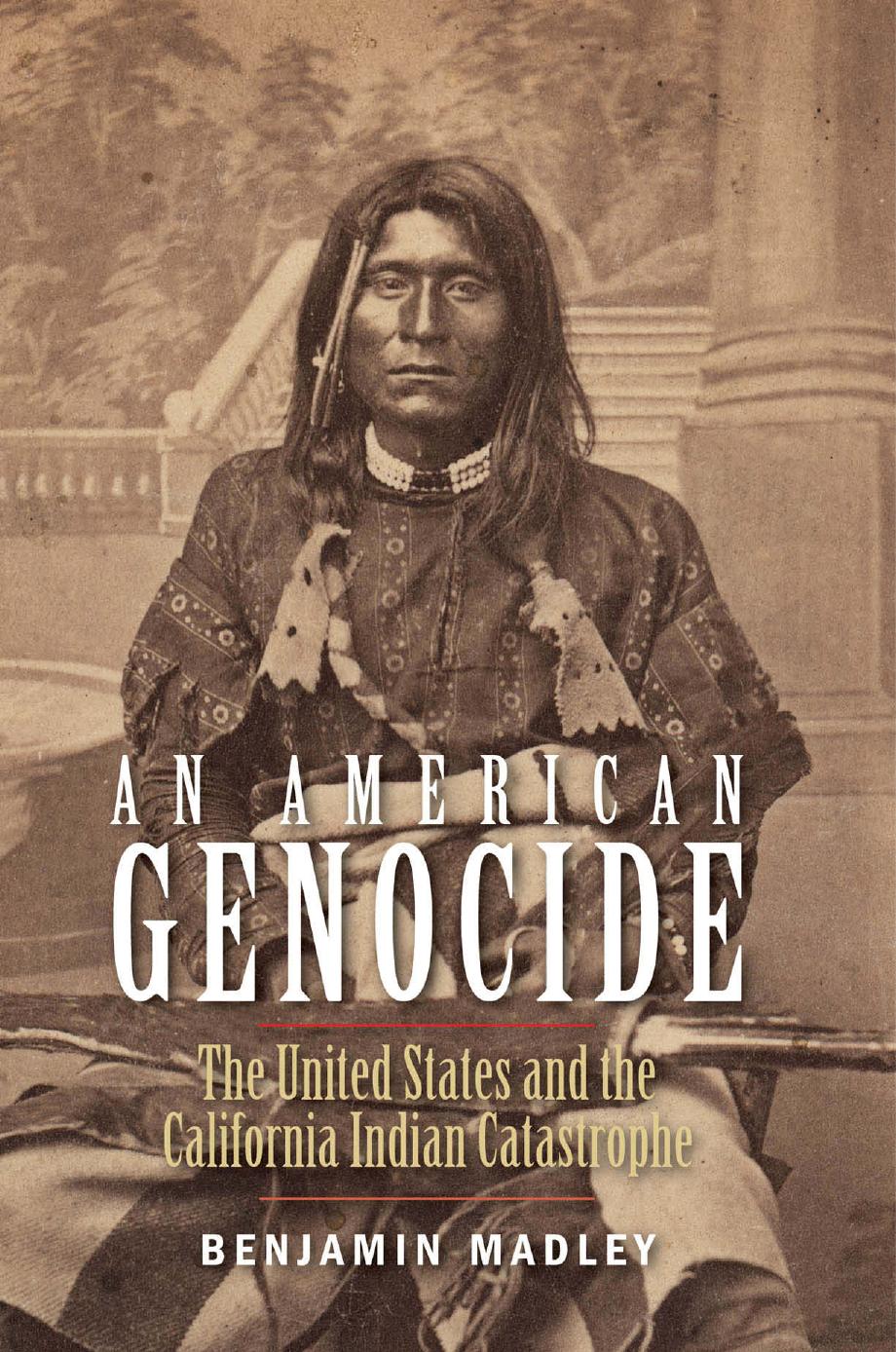
Author:Benjamin Madley [Madley, Benjamin]
Language: eng
Format: epub, pdf
Publisher: Yale University Press
Published: 2016-07-15T06:00:00+00:00
THE PIT RIVER MILITIA EXPEDITION, 1859
In the summer of 1859, the surviving Achumawi, Atsugewi, Maidu, and Yana people east of the Sacramento River were living under increasing pressure and intensifying fear. All three of these peoples had suffered repeated lethal attacks. To avoid slave raiders, soldiers, militiamen, and vigilantes, many of them had retreated ever higher, up valleys and canyons and into the rugged mountains where food was relatively scarce. Yet, with the coming of summer, food supplies increased and the need to raid whites for food diminished. The Achumawi, Atsugewi, Maidu, and Yana peoples thus likely thought themselves in relatively less danger that summer as the days warmed. They did not know that they would soon be the targets of a major state militia operation.
On Independence Day, 1859, Governor Weller ordered militia general Kibbe north, to determine whether or not ranger militiamen should be mustered to fight Tehama County Indians. Kibbe responded by reporting a far bigger problem: a pan-Indian force of 175 to 250 well-armed warriors united against whites in a region extending from Butte Creek to Little Cow Creek and covering much of Butte, Tehama, and Shasta counties. Kibbe’s claims were uncorroborated but provided the pretext for a major Indian-hunting operation. On August 2, Governor Weller ordered him to enroll up to eighty militiamen. Weller did warn Kibbe that “there must be no indiscriminate slaughter of the Indians” and that “women and children must be spared.” Yet this was purely lip service to protect Weller against future criticism. He clearly commanded Kibbe to punish at a time when punishing California Indians routinely meant massacring them. Two weeks later, the general organized a ranger militia company and at Red Bluff, ninety-two volunteers—including Anderson and his group—enlisted for a three-month-long killing campaign.98
General Kibbe’s plan was bold. The operational area—ranging from Butte Creek to the headwaters of the Pit River—encompassed a huge swath of mountainous geography, extending from northern Maidu territory, through Yana lands, and north and east into Achumawi and Astugewi country. To cover this region with ninety-two men, Kibbe divided them into three detachments. Each pierced the campaign zone at a different point, and they all moved south to north, in three subcampaigns. By August 31, the Indian agent Vincent Geiger reported: “An Indian war, under the auspices of the State government, is now being waged against the Indians east of the Sacramento river.” Kibbe’s rangers were marching north.99
Soon after Kibbe’s campaign began, vigilantes and US soldiers took to the field in the Hat Creek and Pit River regions, the northernmost portion of Kibbe’s campaign zone. Local events triggered these operations, but their temporal and geographic overlap with Kibbe’s expedition suggests that the vigilantes and soldiers involved may have taken his presence as carte blanche to launch their own local Indian-killing campaigns. In mid-August, whites found John Callahan and his cook dead at Hat Creek Station. Pit River colonist George Lount reported that because they had been “shot with guns,” the Achumawi, who “have no guns,” could not have committed the killings.
Download
This site does not store any files on its server. We only index and link to content provided by other sites. Please contact the content providers to delete copyright contents if any and email us, we'll remove relevant links or contents immediately.
| Africa | Americas |
| Arctic & Antarctica | Asia |
| Australia & Oceania | Europe |
| Middle East | Russia |
| United States | World |
| Ancient Civilizations | Military |
| Historical Study & Educational Resources |
Cat's cradle by Kurt Vonnegut(15290)
Pimp by Iceberg Slim(14459)
4 3 2 1: A Novel by Paul Auster(12350)
Underground: A Human History of the Worlds Beneath Our Feet by Will Hunt(12068)
The Radium Girls by Kate Moore(11997)
Wiseguy by Nicholas Pileggi(5738)
The Fire Next Time by James Baldwin(5405)
Perfect Rhythm by Jae(5382)
American History Stories, Volume III (Yesterday's Classics) by Pratt Mara L(5283)
Paper Towns by Green John(5156)
Pale Blue Dot by Carl Sagan(4974)
A Higher Loyalty: Truth, Lies, and Leadership by James Comey(4936)
The Mayflower and the Pilgrims' New World by Nathaniel Philbrick(4471)
The Doomsday Machine by Daniel Ellsberg(4467)
Killers of the Flower Moon: The Osage Murders and the Birth of the FBI by David Grann(4421)
The Sympathizer by Viet Thanh Nguyen(4366)
Too Much and Not the Mood by Durga Chew-Bose(4313)
The Borden Murders by Sarah Miller(4296)
Sticky Fingers by Joe Hagan(4163)
